Isaac GR00T reference robot gives humanoid labs a shared hardware target
Original: NVIDIA Announces NVIDIA Isaac GR00T Reference Humanoid Robot for Academic Research View original →
Humanoid robotics does not only need better models. It also needs repeatable hardware, shared data workflows, and a way to compare experiments across labs. NVIDIA’s Isaac GR00T Reference Humanoid Robot targets that gap by combining a Unitree H2 Plus humanoid, Sharpa tactile five-finger hands, Jetson Thor compute, and Isaac GR00T software into an open reference design for academic research.
The hardware is built for human-scale testing. The Unitree H2 chassis stands nearly 6 feet tall and weighs 150 pounds, with 31 degrees of freedom across the body. Dual Sharpa Wave tactile hands add 22 degrees of freedom, bringing the full body and hand system to 75 degrees of freedom. The sensing package includes a head-mounted stereo camera with a 140-degree horizontal and 102-degree vertical field of view, wrist cameras for close-range manipulation, and an inertial measurement unit for motion tracking.
The onboard computer is the Jetson AGX Thor T5000. NVIDIA lists a Blackwell GPU with 2,070 FP4 teraflops, a 14-core Arm CPU, 128GB of unified memory, and a configurable 40-130W power range for real-time sensor processing and robot inference. The robot has arm torque up to 120 Newton-meters, leg torque up to 360 Newton-meters, a rated arm payload of 7 kilograms, and a peak payload of 15 kilograms. Its 0.972kWh battery is described as supporting about three hours of operation.
The software stack matters because it covers the full development loop. Isaac Teleop handles demonstration data capture. Isaac GR00T open foundation models support humanoid reasoning and multitask behavior. Isaac Sim and Isaac Lab cover simulation, training, testing, and policy evaluation. Isaac ROS middleware moves trained policies onto physical robots. NVIDIA says researchers retain control of robot data, training data, telemetry, and logs.
Ai2, ETH Zurich, Stanford Robotics Center, and UC San Diego’s Advanced Robotics and Controls Laboratory are named among early research institutions using the reference design. The robot is expected to be available from Unitree in late 2026, while a Unitree G1 reference workflow is expected soon on GitHub and Hugging Face. The big test will be whether a common reference platform can reduce duplication and make humanoid results easier to reproduce outside the lab that produced them.
Related Articles
NVIDIA said on March 20, 2026 that its Cosmos world foundation models have advanced again with Transfer 2.5, Predict 2.5, and Reason 2. The linked NVIDIA Technical Blog frames the update around higher-quality synthetic data, stronger long-tail scenario generation, and richer reasoning for robots and autonomous vehicles.
ABB Robotics and NVIDIA said they are integrating Omniverse libraries into RobotStudio and plan to ship RobotStudio HyperReality in the second half of 2026. They claim 99% sim-to-real correlation and say the platform can cut engineering time, reduce deployment cost, and speed factory rollout.
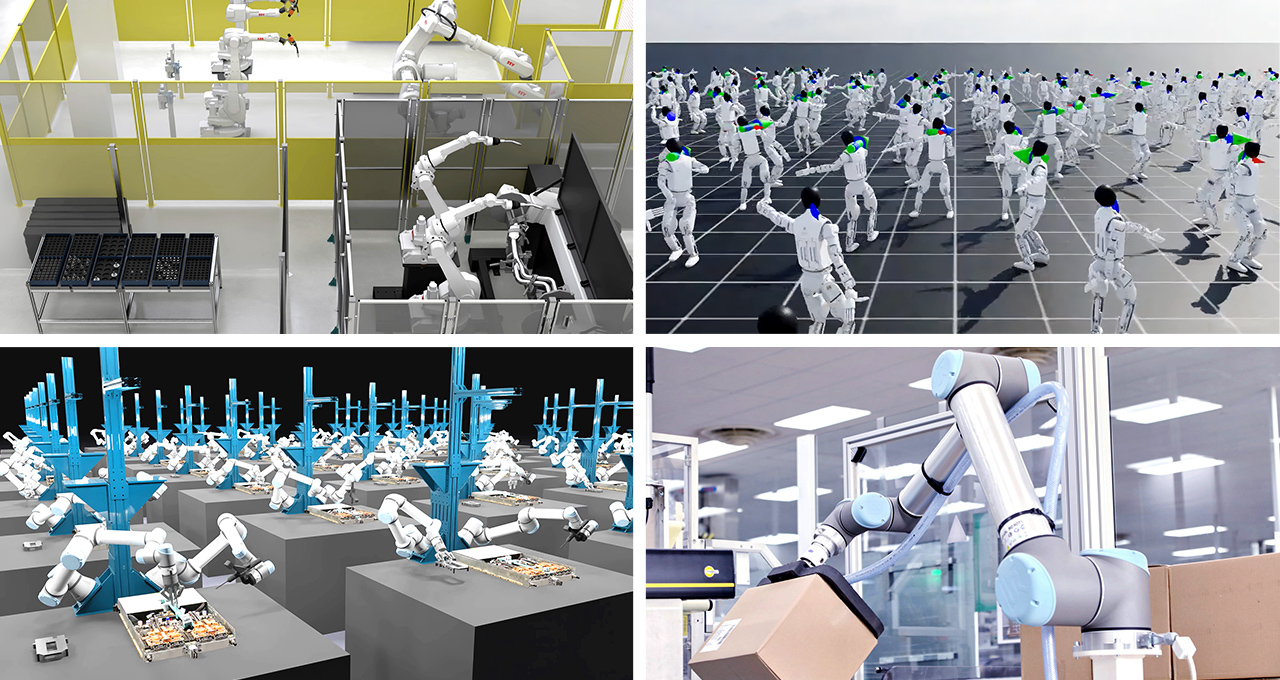
NVIDIA said on March 16, 2026 that ABB, FANUC, Figure, KUKA, Skild AI and other robotics players are building on Cosmos, Isaac and GR00T to move physical AI from simulation into production. The release also introduced Cosmos 3, Isaac Lab 3.0 in early access, and commercial early access for GR00T N1.7.