This is less about one more cloud partnership and more about the infrastructure shape of the next agent wave. NVIDIA and Google Cloud say A5X Rubin systems can scale to 80,000 GPUs per site and 960,000 across multisite clusters, while cutting inference cost per token and boosting token throughput per megawatt by up to 10x versus the prior generation.
#physical-ai
RSS FeedGeneralist says GEN-1 crosses a commercial threshold for simple physical tasks by combining higher success rates, faster execution, and lower task-specific robot data requirements.
NVIDIA announced its Open Physical AI Data Factory Blueprint on March 16, 2026 to speed development for robotics, vision AI agents and autonomous vehicles. The blueprint is designed to turn limited real-world data into larger, more diverse training pipelines with synthetic generation and automated evaluation.
On March 16, 2026, Microsoft used NVIDIA GTC to expand Foundry Agent Service and observability, add NVIDIA Nemotron models, outline Azure infrastructure built for inference-heavy reasoning workloads, and introduce an Azure Physical AI Toolchain. The announcement is notable because it connects agent operations, hyperscale AI infrastructure, and physical-world systems in one stack.
NVIDIA said on March 12, 2026 that TensorRT Edge-LLM now supports MoE models, Nemotron 2 Nano, Qwen3-TTS/ASR, and Cosmos Reason 2 on Jetson and DRIVE platforms. The company is positioning the runtime as a low-latency edge reasoning layer for robotics and autonomous vehicles.
NVIDIA said on March 20, 2026 that its Cosmos world foundation models have advanced again with Transfer 2.5, Predict 2.5, and Reason 2. The linked NVIDIA Technical Blog frames the update around higher-quality synthetic data, stronger long-tail scenario generation, and richer reasoning for robots and autonomous vehicles.
NVIDIA on March 16, 2026 introduced an open reference architecture for generating, augmenting and evaluating training data for robotics, vision AI agents and autonomous vehicles. Microsoft Azure and Nebius are integrating the blueprint, and NVIDIA said the package is expected to land on GitHub in April.
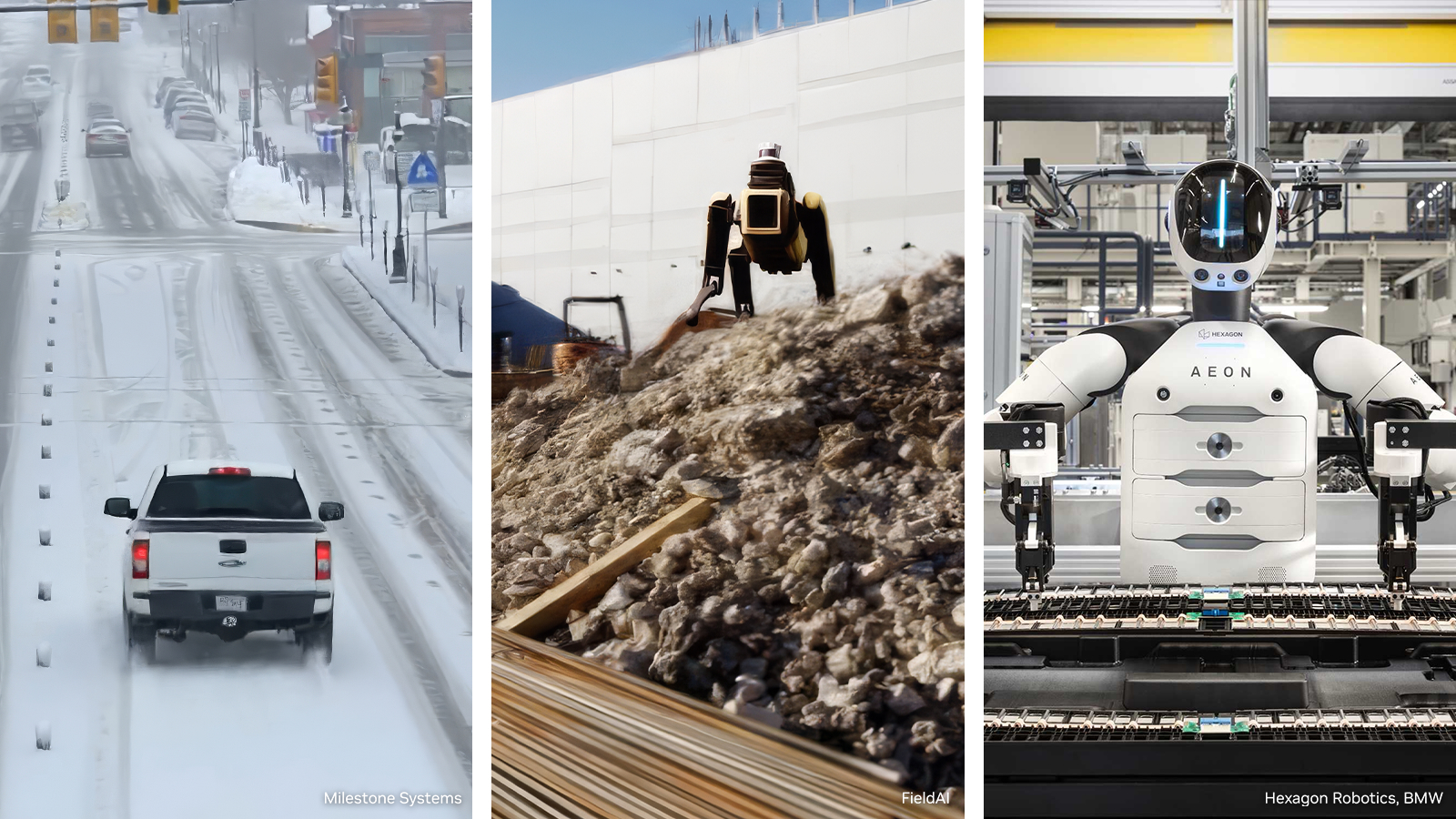
NVIDIA said on March 16, 2026 that ABB, FANUC, Figure, KUKA, Skild AI and other robotics players are building on Cosmos, Isaac and GR00T to move physical AI from simulation into production. The release also introduced Cosmos 3, Isaac Lab 3.0 in early access, and commercial early access for GR00T N1.7.
NVIDIA on March 16, 2026 introduced its Physical AI Data Factory Blueprint, an open reference architecture for generating, augmenting, and evaluating training data for robotics, vision AI agents, and autonomous vehicles. The company says the stack combines Cosmos models, coding agents, and cloud infrastructure from partners such as Microsoft Azure and Nebius to lower the cost and time of physical AI training at scale.
Microsoft used NVIDIA GTC on March 16, 2026 to widen Microsoft Foundry and Azure AI in three directions: production agent tooling, next-generation NVIDIA infrastructure, and Physical AI workflows. The company said Foundry Agent Service is now generally available, Nemotron models are coming to Foundry, and Azure is already powering on NVIDIA Vera Rubin NVL72 in Microsoft labs.
NVIDIA announced an open Physical AI Data Factory Blueprint on March 16, 2026. The reference architecture is designed to unify data generation, augmentation, and evaluation for robotics, vision AI agents, and autonomous vehicles, with GitHub availability expected in April.
NVIDIA and ABB Robotics are integrating Omniverse libraries into RobotStudio to bring industrial-grade physical AI simulation to factory automation. The companies say RobotStudio HyperReality reaches 99% sim-to-real accuracy and can cut deployment costs by up to 40%.