NVIDIA puts 4B Cosmos 3 Edge at the center of local physical AI
Original: At SIGGRAPH, NVIDIA Advances Graphics and Simulation With Agentic and Physical AI View original →
The practical question for physical AI is no longer only model capability; it is where the system can run. NVIDIA’s July 20 SIGGRAPH update puts that question in the foreground with a package aimed at robots, video verification, simulation, and local creative agents. In its official SIGGRAPH post, NVIDIA tied together Cosmos 3 Edge, Synthetic Video Detector NIM, Model Context Protocol connections for creative tools, and the DGX Station Agent Toolkit.
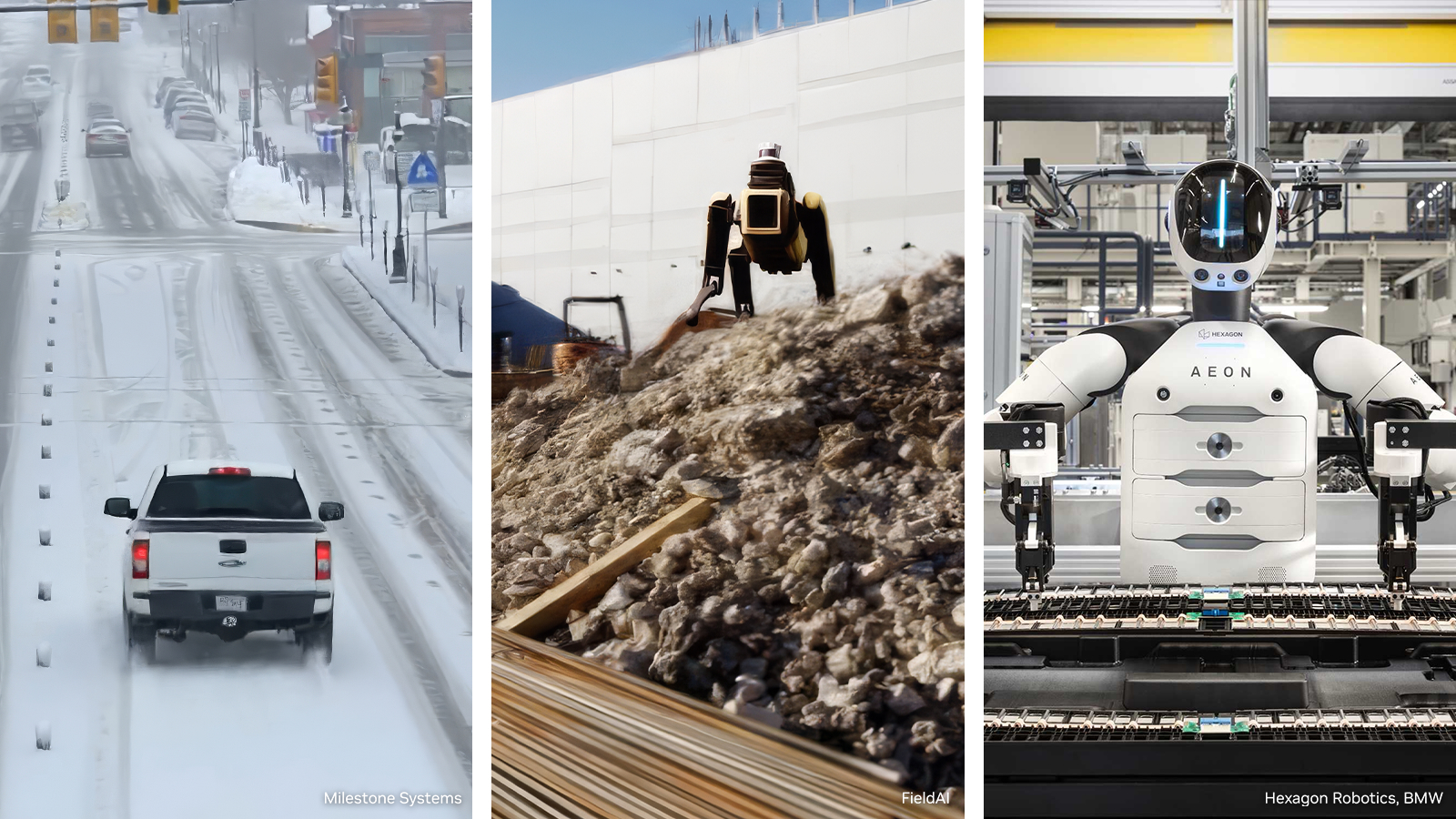
The clearest product shift is Cosmos 3 Edge. NVIDIA describes it as a 4-billion-parameter omnimodel optimized for memory-efficient, high-throughput deployment on Jetson, RTX PRO, DGX, and GeForce RTX GPUs. It can work across text, image, video, ambient sound, and action, while its mixture-of-transformers design is aimed at physically grounded, real-time vision analytics and robot action on device. NVIDIA says Cosmos 3 Edge ranks No. 1 on VANTAGE-Bench for vision analytics success in its parameter class.
The media-verification piece is also concrete. The Synthetic Video Detector NIM microservice analyzes video frame by frame and returns a classifier score for synthetic content. NVIDIA reports accuracy of up to 92% on uncompressed video, 87% at 15% compression, and 82% at 50% compression. The service can process 1080p video in as little as 22 milliseconds on NVIDIA RTX systems and about 30 milliseconds on NVIDIA L40 GPUs. Wowza is embedding it into a livestreaming framework used across more than 35,000 deployments in over 170 countries.
NVIDIA is also pushing local agents into professional systems. The DGX Station Agent Toolkit combines NemoClaw, Nemotron 3 Ultra, Omniverse libraries, and the OpenShell secure runtime. Nemotron 3 Ultra is described as a 550-billion-parameter open model, while DGX Station GB300 systems offer up to 20 petaflops of FP4 AI compute and 748GB of coherent memory. The pitch is not just faster inference; it is letting teams keep proprietary scenes, sensor data, and simulation workflows inside controlled local infrastructure.
The next test is operational rather than theatrical. Cosmos 3 Edge is available on Hugging Face and GitHub, but robotics teams, newsroom vendors, and industrial customers still have to prove latency, false-positive rates, tuning cost, and reliability outside NVIDIA’s SIGGRAPH demos.
Related Articles

NVIDIA showed Cosmos 3 Nano rising from 54.41% zero-shot accuracy to 93.35% after LoRA and TAO AutoML on a traffic safety video QA task. The result frames agent-run post-training as a practical physical AI workflow.

Video analytics development is moving from hand-built pipeline wiring toward natural-language instructions plus coding agents. DeepStream 9.1 adds 13 agentic skills and JetPack 7.2 support.
NVIDIA on March 16, 2026 introduced an open reference architecture for generating, augmenting and evaluating training data for robotics, vision AI agents and autonomous vehicles. Microsoft Azure and Nebius are integrating the blueprint, and NVIDIA said the package is expected to land on GitHub in April.