NVIDIA turns physical AI workflows into open-source agent skills
Original: NVIDIA Releases Major Collection of Open Source Agent Tools and Skills for Physical AI View original →
Robotics and factory AI work is starting to look like something coding agents can execute, not just assist with. On May 31, 2026, NVIDIA released an open-source collection of physical AI skills and tools that turn workflows across Omniverse, Cosmos, Isaac, Metropolis, Alpamayo, and Jetson into agent-callable instructions.
The change matters because physical AI development is a long chain: generate synthetic data, build or reconstruct simulations, train models, evaluate behavior, tune deployment targets, and verify results. NVIDIA says the new skills specify which tools an agent should call, what outputs it should produce, and how developers can validate the result. The skills can also be used with NemoClaw and OpenShell, giving teams policy-based security and privacy controls on local or cloud hardware.
The scope is broad. Robotics and edge-AI teams can use the skills for perception and mobility training data, navigation training, robot learning, and Jetson deployment tuning. Autonomous-vehicle developers can reconstruct fleet data into simulation environments, generate photorealistic driving scenarios, and run closed-loop reinforcement-learning workflows. Vision-AI and industrial teams get paths for synthetic data, fine-tuning, automated labeling, video agents, and CAD-to-digital-twin conversion.
The most useful part of the release is the field data NVIDIA includes. Pegatron cut model training and deployment time by 67% using synthetic data from the Defect Image Generation skill. Delta Electronics used synthetic defect data to improve detection of excess soldering on metal busbars by 17%. Inventec reduced defect-data collection effort for laptop chassis manufacturing by 30%, while Foxconn, working with DeepHow, reported an approximately 3% first-pass-yield boost.
The tools are available through GitHub and skills.sh, while Neural Reconstruction, Video Augmentation, and Defect Image Generation skills can be tried through NVIDIA Brev Physical AI Launchables. The open question is governance. When agents automate simulation and synthetic-data loops, validation becomes the high-stakes part of the workflow. Physical AI will not be judged only by faster iteration; it will be judged by whether those iterations can be trusted before they reach robots, vehicles, factories, and hospitals.
Related Articles
NVIDIA said on March 20, 2026 that its Cosmos world foundation models have advanced again with Transfer 2.5, Predict 2.5, and Reason 2. The linked NVIDIA Technical Blog frames the update around higher-quality synthetic data, stronger long-tail scenario generation, and richer reasoning for robots and autonomous vehicles.
ABB Robotics and NVIDIA said they are integrating Omniverse libraries into RobotStudio and plan to ship RobotStudio HyperReality in the second half of 2026. They claim 99% sim-to-real correlation and say the platform can cut engineering time, reduce deployment cost, and speed factory rollout.
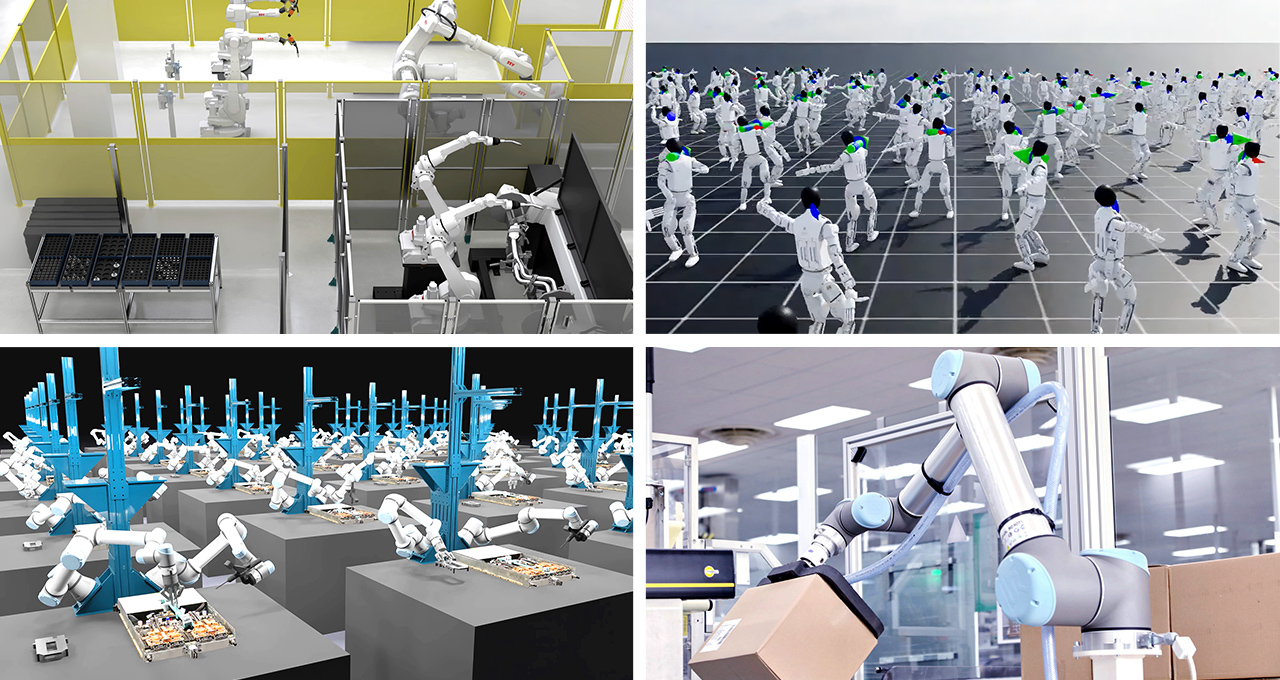
NVIDIA said on March 16, 2026 that ABB, FANUC, Figure, KUKA, Skild AI and other robotics players are building on Cosmos, Isaac and GR00T to move physical AI from simulation into production. The release also introduced Cosmos 3, Isaac Lab 3.0 in early access, and commercial early access for GR00T N1.7.