DeepMind's Decoupled DiLoCo chases zero-downtime LLM training
Original: Decoupled DiLoCo: A new frontier for resilient, distributed AI training View original →
DeepMind's Decoupled DiLoCo is aimed at an infrastructure headache that has become more painful as model training sprawls across bigger clusters: one lagging learner, failed chip or synchronization hiccup can waste compute for everyone. In classical SPMD-style pretraining, the whole run tends to move in lockstep. That architecture has been effective, but it becomes increasingly brittle as labs chase larger models and more geographically distributed compute.
The new approach tries to break that lockstep. Instead of forcing all learners to wait for one another, Decoupled DiLoCo partitions compute into independent learners that run local optimization steps and asynchronously send parameter fragments to a central synchronizer. The synchronizer then aggregates updates with a minimum quorum, an adaptive grace window and token-weighted merging. In plain English: the system is designed to keep training moving even when part of the cluster slows down or drops out.
The claim that matters most is not just bandwidth reduction but uptime. In the arXiv abstract, the DeepMind team says the method delivers strictly zero global downtime in failure-prone environments with millions of simulated chips, while keeping competitive model quality across text and vision tasks and across both dense and mixture-of-experts models. The accompanying DeepMind post makes the practical pitch even clearer: this is meant to help frontier LLM training span distant data centers with lower communication overhead and higher resilience.
If that sounds like infrastructure plumbing, it is. But this is the kind of plumbing that shapes who can actually train frontier systems. Training curves are now constrained as much by cluster reliability, networking and recovery behavior as by raw model design. A method that tolerates local failure better could let labs squeeze more useful work out of imperfect hardware instead of waiting for giant, perfectly synchronized islands of compute.
The caution is obvious: the strongest result in the paper is still framed around simulated failure-heavy environments, not a long public ledger of production runs. Even so, the timing matters. As leading labs scramble for capacity, the economics of resilience are starting to look as important as the economics of scale. DeepMind's bet is explicit: the next frontier in LLM training may be learning how not to stop.
Related Articles
Google launched Gemini 3.5 Flash at I/O 2026 on May 19, making it generally available the same day. It outperforms Gemini 3.1 Pro on coding and agentic benchmarks while running 4x faster at 40% lower cost.
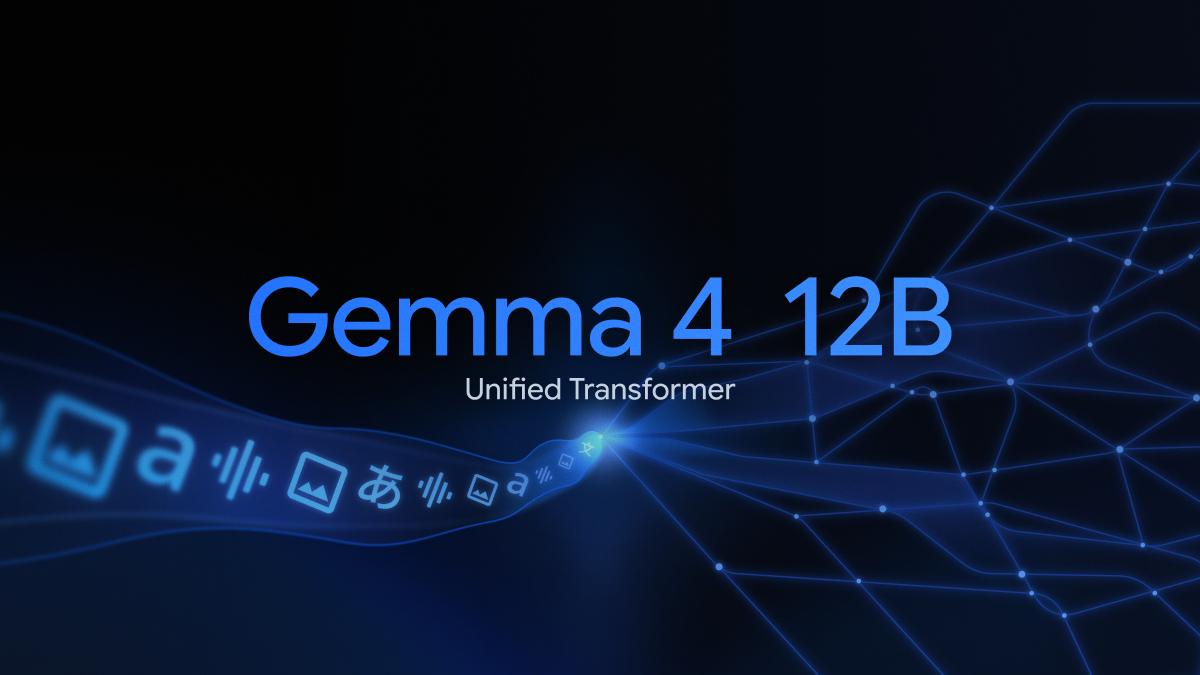
The thread’s energy centered on the architecture claim: what does “encoder-free” really mean for a 12B multimodal model?

Local multimodal AI is moving into the 12B class. Google Gemma introduced Gemma 4 12B under Apache 2.0, describing a unified encoder-free design for image, audio, and text inputs.