HN Spotlight: Karpathy's <code>microgpt</code> distills GPT training and inference into ~200 lines
Original: Microgpt View original →
Why this HN thread drew strong attention
The Hacker News post titled Microgpt reached a score of 732 with 120 comments at crawl time, signaling unusually broad engagement for a technical learning resource. The linked article, published by Andrej Karpathy on 2026-02-12, presents an explicit goal: reduce the algorithmic core of GPT training and inference to a minimal, readable implementation that still runs end to end.
What is actually inside the project
According to the source write-up, the single Python file includes the full pipeline: a document dataset, a simple tokenizer, a hand-built autograd engine, a GPT-2-like model architecture, Adam optimization, a training loop, and an inference loop. The point is not benchmark performance. The point is to expose the moving parts in one place so readers can trace how next-token prediction works from raw text to generated output.
The example dataset is 32,000 names. The tokenizer is character-based with a BOS token delimiter. The post describes a tiny setup with 4,192 parameters and a 1,000-step training run where loss decreases from around 3.3 (close to random guessing over the tiny vocabulary) to around 2.37. This is intentionally small-scale, but it demonstrates that even a compact script can learn statistical patterns and sample plausible outputs.
Technical takeaways for practitioners
- The code connects tokenization, model forward pass, loss, backpropagation, and parameter updates without hidden framework abstractions.
- It provides a concrete mental model for how KV-cache style state appears in token-by-token execution.
- It clarifies which parts are algorithmic essentials versus engineering layers added in production systems.
Limits and practical value
This is an educational artifact, not a production recipe. It does not attempt distributed training, large-scale data curation, serving throughput optimization, or memory-efficient kernels. Those concerns remain critical in real deployments. Still, the artifact is valuable because many current discussions about agents and orchestration skip over core model mechanics. microgpt gives teams a shared low-level reference when debating architecture choices, evaluation strategy, and inference constraints.
For engineers onboarding to LLM systems, the project can function as a compact map: understand this script first, then layer on optimization, tooling, and infrastructure complexity. That framing explains why the HN thread resonated far beyond beginner audiences.
Sources: Hacker News thread, Karpathy blog post, microgpt.py gist
Related Articles
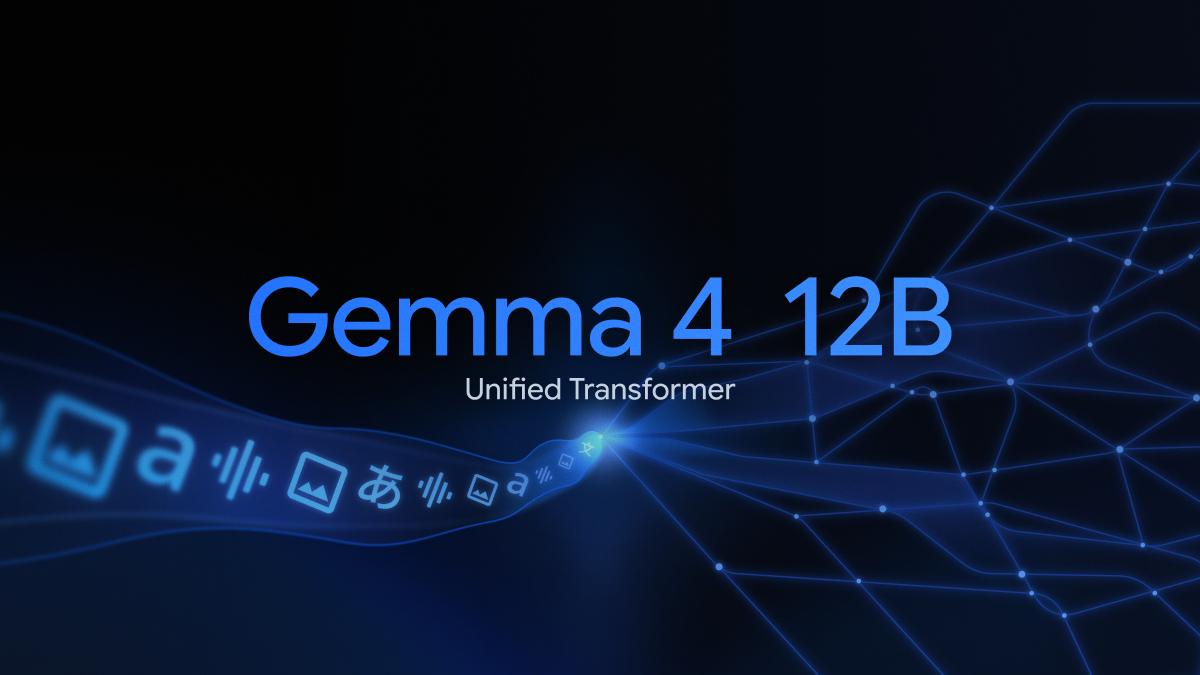
The thread’s energy centered on the architecture claim: what does “encoder-free” really mean for a 12B multimodal model?

Local multimodal AI is moving into the 12B class. Google Gemma introduced Gemma 4 12B under Apache 2.0, describing a unified encoder-free design for image, audio, and text inputs.

Open-model competition is shifting from leaderboard scores to agent operating costs. NVIDIA says Nemotron 3 Ultra is a 550B MoE model with 5x faster inference and up to 30% lower cost for complex agentic tasks.