Microsoft Links Foundry Agents, Vera Rubin Infrastructure, and Physical AI at NVIDIA GTC
Original: Microsoft at NVIDIA GTC: New solutions for Microsoft Foundry, Azure AI infrastructure and Physical AI View original →
Microsoft bundled agent operations, AI infrastructure, and Physical AI into one enterprise story
On March 16, 2026, Microsoft used NVIDIA GTC to push three parts of its AI strategy forward at once. The first was a stronger Microsoft Foundry stack for building and operating production-ready agents. The second was new Azure infrastructure aimed at inference-heavy, reasoning-based workloads. The third was a deeper move into Physical AI, with tooling meant to connect simulation, operational data, and cloud-scale model deployment. Taken together, the announcement shows Microsoft trying to present AI not as a collection of separate services, but as a continuous enterprise system from model choice to real-world operations.
Microsoft said Foundry Agent Service and observability in the Foundry Control Plane are now generally available. It also introduced a Voice Live API integration in public preview and said NVIDIA Nemotron models are now available through Foundry. That matters because enterprise buyers increasingly care less about isolated demos and more about whether agent systems can be monitored, governed, secured, and run at scale inside production environments.
Foundry is being positioned as an operating layer for enterprise agents
Microsoft describes Foundry as an operating system for building, deploying, and operating AI at enterprise scale. This update makes that framing more concrete. Agent Service is meant to help teams build systems that reason, plan, and act across tools, data, and workflows. The Control Plane adds end-to-end visibility into agent behavior, which is central to both developer productivity and enterprise trust. With portal updates, security integrations from Prisma AIRS and Zenity, and the Voice Live API path for real-time multimodal experiences, Microsoft is trying to reduce the gap between a promising prototype and a governable production system.
Adding NVIDIA Nemotron models reinforces another point: Microsoft is not narrowing Foundry into a single-model environment. Instead, it is turning the platform into a place where customers can mix frontier, reasoning, and open models while keeping deployment, observability, and governance consistent. For enterprises, that can be more valuable than picking one flagship model if it lowers operational friction across teams and regions.
Azure infrastructure is shifting toward reasoning-era inference
On the infrastructure side, Microsoft said it is the first hyperscale cloud to power on NVIDIA Vera Rubin NVL72 systems in its labs. It also said it has deployed hundreds of thousands of liquid-cooled Grace Blackwell GPUs across its global datacenter footprint in less than a year. The message is clear: Microsoft sees the next infrastructure bottleneck not only in training, but also in the sustained inference load created by reasoning models and long-running agents.
The company also extended that strategy into controlled environments. Microsoft announced initial support for the Vera Rubin platform on Azure Local, which gives regulated and sovereign customers a way to prepare for next-generation AI workloads without stepping outside Azure-consistent operations, governance, and security. That is important because many of the most valuable AI use cases sit inside industries that cannot rely on a public-cloud-only model.
Physical AI is the third leg of the strategy
Microsoft also introduced a public Azure Physical AI Toolchain GitHub repository tied to the NVIDIA Physical AI Data Factory Blueprint, and it said it is deepening integration between Microsoft Fabric and NVIDIA Omniverse libraries. The goal is to let companies connect live operational data, digital twins, simulation, and cloud training into repeatable pipelines for robotics and other physical systems. That is a sign Microsoft wants to compete not only in digital copilots and coding agents, but also in the software layer that runs AI in factories, energy facilities, and other industrial environments.
The broader significance is strategic. Microsoft is presenting agent software, inference infrastructure, and Physical AI as parts of one enterprise stack. The next questions are execution questions: how quickly Foundry Agent Service becomes a default operating layer, how fast Vera Rubin systems roll into Azure regions, and whether the Physical AI toolchain translates into repeatable customer deployments beyond demos and pilots.
Source: Microsoft
Related Articles

NVIDIA showed Cosmos 3 Nano rising from 54.41% zero-shot accuracy to 93.35% after LoRA and TAO AutoML on a traffic safety video QA task. The result frames agent-run post-training as a practical physical AI workflow.
Microsoft announced Maia 200 (codenamed Braga) on 2026-01-26 as its second-generation in-house AI accelerator. The company says selected Copilot and Azure AI workloads show up to 1.7x performance versus Maia 100.
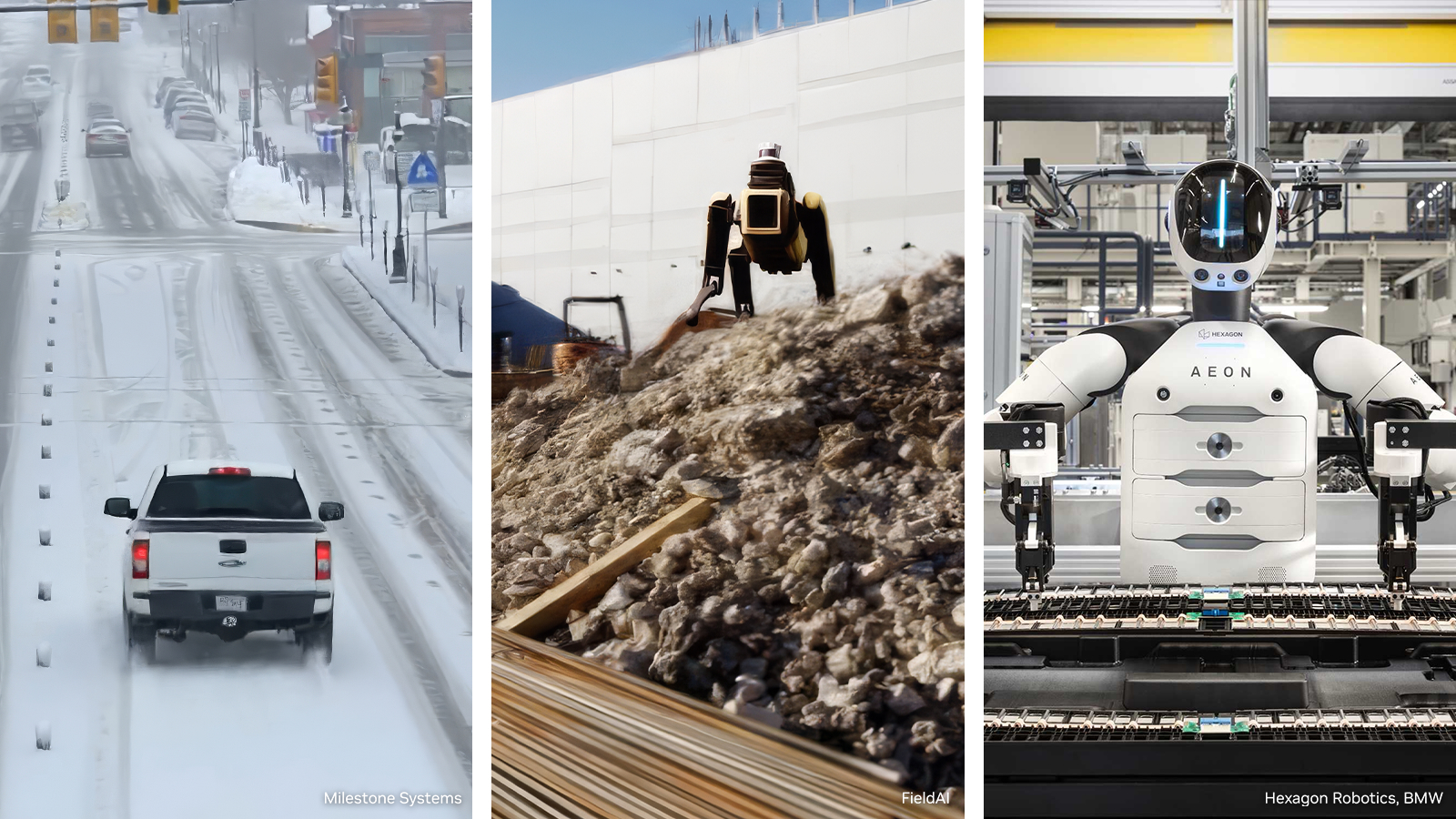
NVIDIA on March 16, 2026 introduced an open reference architecture for generating, augmenting and evaluating training data for robotics, vision AI agents and autonomous vehicles. Microsoft Azure and Nebius are integrating the blueprint, and NVIDIA said the package is expected to land on GitHub in April.